
The challenge
Most prop firms sell challenges and quietly profit when traders fail. Carrot wanted to invert that model: deploy real capital behind proven traders, share the upside, and make every rule, fill and payout something an outsider could verify.
That promise only holds if the plumbing is trustworthy. Building it in-house would have meant custody, capital controls, profit-sharing logic and an auditable ledger - all as custom smart contracts, all needing audits before a cent moved.
Why Rethink
Carrot built the firm on Rethink instead of reinventing that infrastructure. Capital sits in non-custodial vaults, execution is scoped on-chain, and the rules that define a challenge are enforced by infrastructure rather than promised in a rulebook.
- Enforced, not asserted. Execution, capital and profit-sharing run through Rethink's infrastructure - verifiable on-chain rather than left to the firm's discretion.
- On-chain payouts. Funded traders are paid in USDC, on-demand, with every settlement recorded as a transaction anyone can check.
- No Solidity. Carrot's team focused entirely on the funding model, risk rules and trader experience - not contract engineering.
"A prop firm only works if traders trust the rules. Putting execution and payouts on-chain - without writing the contracts ourselves - is what makes Carrot verifiable by design."
- Carrot FundingWhat they built
On top of Rethink, Carrot shipped its own trading terminal - a fully branded experience where traders run the challenge, get funded, and request payouts without platform-hopping or external logins. Underneath, Rethink handles custody, accounting and settlement.
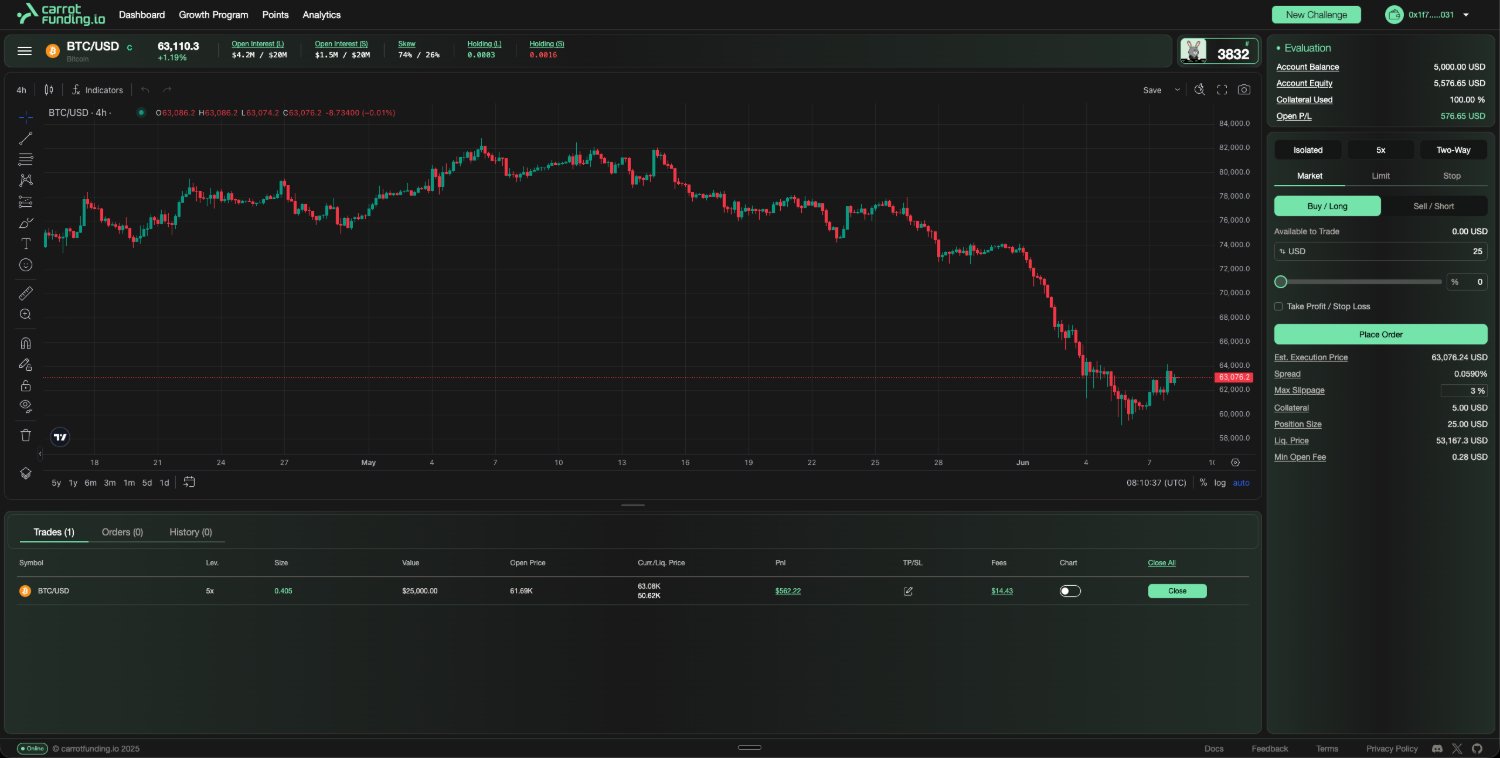
Because the track record lives on-chain, Carrot can publish a transparent leaderboard of funded traders, every payout linked to a verifiable transaction.
The outcome
A modern prop firm that bets on traders instead of against them - with capital, rules and payouts that anyone can verify, all delivered through Carrot's own product and none of it requiring a contract the team had to write.